Because it is completely open source under a “general public license”
You literally become the full legal owner
of every copy of Blender you download and third part python developers can freely access every part of the code base with no legal restrictions on distributing/selling whatever they have pulled out of the Blender code in the form of a special purpose addon.
Even specially enhanced versions of the entire application can be legally sold
if buyers find it worth their money.
12 hours? That is not much for a sim like this. I’ve had cloth simulations take longer than that.
I know technically I could commit my main PC to a 12-20 hour fluid simulation and still have two older laptops, My Imac and my linux machine for other work and play but that simulation would need to be part of some paid project not just something I
would do just to put up on youtube and get
only 43 views because its not Warhammer40K
As AutoDidact already explained, Blender being free and open source, the barrier to entry for developers of plug-ins and add-ons is comparatively low and the community large, thus making developing for Blender attractive. Any developments for C4D are primarily up to Maxon and they have limited resources. Yes, there are plug-ins for C4D (X-Particles being one of the more well-known ones), but, as far as I know, the barrier for third-party developers is higher for C4D than for Blender and there are probably fewer C4D users (i.e., fewer potential customers) as well.
Even though the main software is free, I understand that this not the case for all the add-ons; I’d feel a bit weird about using a free software with paid add-ons, but maybe that’s just me.
If I were starting out fresh in 3D, a lot younger, and on a tight budget, I’d probably also go the Blender route. However, it has taken me 20+ years to get to where I am with C4D and I don’t want to spend years more just to get to the same level in Blender (also, I don’t want to throw out all the C4D assets that I paid for and wouldn’t be able to use with Blender). Since I’m a slow learner and no spring chicken anymore, I’ll probably stick with C4D—all my previous attempts at getting into Blender have failed miserably, so I’m not keen on repeating that experience. YMMV.
See, I would do it for 43 views on YouTube because I’d be doing it for me (i.e., for the fun of it), not any audience or client. A paid project is not an option for me (for a variety of reasons, I couldn’t accept money for CG), so the only other alternative would be me not doing the sim and not posting anything, which I don’t find all that appealing, either.
Any developments for C4D are primarily up to Maxon and they have limited resources.
I think it is more a matter of priorities for Maxon’s parent company, the software conglomerate called Nemetschek.
They actually make alot of Architecture, Engineering and Construction software, and are more a direct competitor in that space to Autodesk.
All of the software they have acquired (including Zbrush) is monthly sub so there is no shortage of steady revenue.
Maxon targets a user demographic that does not seem interested in Advanced Character rigging and animation
or complex Hollywood film quality visual effects work
and that is perfectly fine as there are other softwares
(Maya ,Max ,Houdini,) for people who need such features.
Even though the main software is free, I understand that this not the case for all the add-ons; I’d feel a bit weird about using a free software with paid add-ons, but maybe that’s just me.
Actually the Blender “business model” is the ideal situation situation for the majority of individual users.
because you get to decide what areas of the program you want to “enhance” beyond the base features instead of being at the mercy of the official company software devs who might have other priorities.(see Daz and IK systems)
And the addons are typically a very affordable way to get something done that is extremely difficult or even impossible
with the default tools.
Like that 15 Dollar “easy wake” addon that I (gave in to temptation)and grabbed yesterday
it previews in realtime and is an awesome fast and cheap solution for such animations on the water.
Blender is not a charity and is only “free” because the Blender Foundation, which is funded in various ways, provides capital. So paying for add-ons makes sense as this supports third-party developers. But calling it “free” is a clever strategy as it attracts those that feel that all software should be “free”. Once you grow up, you find out that the world doesn’t work that way, unfortunately.
Now Blender provides of course a great opportunity to enter into 3D with little cost, so that is a good thing. I never really got into it. Learning one software is hard enough.
Additionally if you buy addons from the Blender market store, a portion of that sale goes to the Blender development fund
and it is a great incentive to support addon devs who care about the things I care about, like Character animation.
The $40 Autorig Pro addon ,that I use ,was created by a former Pixar animator several years ago ,who was frustrated with the native rigging & mocap retarget abilities of Blender back then.
It remains one of the top selling addons on Blender market and he updates it regularly.
There used to be a very active third party plugin community for Maxon C4D back in the 2,000’s when I started with version RDXL7.
There was fluid dynamics, mass vegetation systems, Character rigging with mocap retargeting, crowd simulation.
A complete poser import plugin that Auroratrek
used for his Star Trek series/Movie and that I used for most of my “Galactus Rising” Movie .
But there was ALOT of frustration as Maxon would regularly release a decimal point “upgrade” to the base application (7.078-7.095)that would break most ALL of the third party plugins so the third party market for C4D pretty much died except for a few hold outs making lighting and material setup product like Nick over at “Greyscale Gorilla”
or the guys over at Insidyum who lost alot of paying subscribers when Maxon upgraded the native cloth ,Smoke& pryo system of C4D under a unified structure.
Okay, thanks all for the explanation of Blender vs. C4D. Hopefully C4D will catch up on fluid sims soon.
I hear you on this! I did look into Blender a couple of times, but I couldn’t make heads or tails of it, same with Unreal Engine. I’m relatively computer and software savvy, but the thought of trying to learn a whole new ecosystem is just too exhausting to contemplate. I guess one upside of doing my own stuff means I can just decide to write scenes that only contain elements I know I can create in C4D.
I have the same with iClone. There are certainly limitations, but over the years I’ve found workarounds or I make adjustments to the story. The audience doesn’t really care about our troubles…
I’m relatively computer and software savvy, but the thought of trying to learn a whole new ecosystem is just too exhausting to contemplate.
Yeah, I consider myself very savvy with animation systems and have gotten pretty decent at rigging and fixing weight maps.
But where I struggle is with learning a new material system
for these “high end” render engines.
that is where I am struggling with Maya indie.
The Blender pipeline tool from Reallusion somehow actually seems to improve the look of iclone characters
materials even with EEVEE and I am super comfortable with Blender material node system when needed.
Yes Maya’ Arnold has a rudimentery “convert materials to Arnold” button just like Vray in C4D does.
But My Daz or CC Characters look pretty awful with those
auto converted materials so I know to get the best of Arnold I will have to learn to build Arnold materials manually.
which is making seriously debate if I will renew My $300 per year Maya indie license in Dec 2025.
And Unreal Engine??
Forget it!..…they can keep their “realism”
I get a headache just watching other people use it in tutorials.
The audience doesn’t really care about our troubles…
Nor do they give you any points for having spent days rendering some massive fluid/cloth simulation if the story/genre does not appeal to them.
Yes, but, since the development of C4D is ongoing (there are useful additions/improvements several times a year), what you can create without leaving C4D keeps expanding (I realize other software, such as Blender, also advances, but here we are talking about C4D specifically).
For me, the new cloth and physics engine was a game changer. If Maxon revamps the ancient hair system and adds fluid dynamics, I’ll be a happy camper. Frankly, I don’t care about character rigging, animation, etc. in C4D. That’s what I’ve got iClone for.
Why should they? The only people who may (perhaps) care are those in the same “field”, who appreciate the trouble/amount of work that went into creating something CG.
Again, why should they? It’s not realistic to expect them to. Audiences are also jaded by what AI can do these days. I’ve had people comment on clips of mine with “Nice AI”; they appeared surprised when I explained that while it was CG, it was not an AI generated animation.
General audiences respond to content that appeals to them emotionally (i.e., cute characters, an interesting story, or something that triggers them). I have no talents creating or telling stories (nor am I all that interested in doing that), so I’ll stick to my little tech demos (besides, unless the “story” could be told within 30-60 seconds or so, render times would probably not make it feasible for me—I don’t have Tim’s patience and self-discipline to stick to one project for months and years).
That is why I produce my content primarily for an audience of one (i.e., myself); anybody else is just along for the ride—or not.
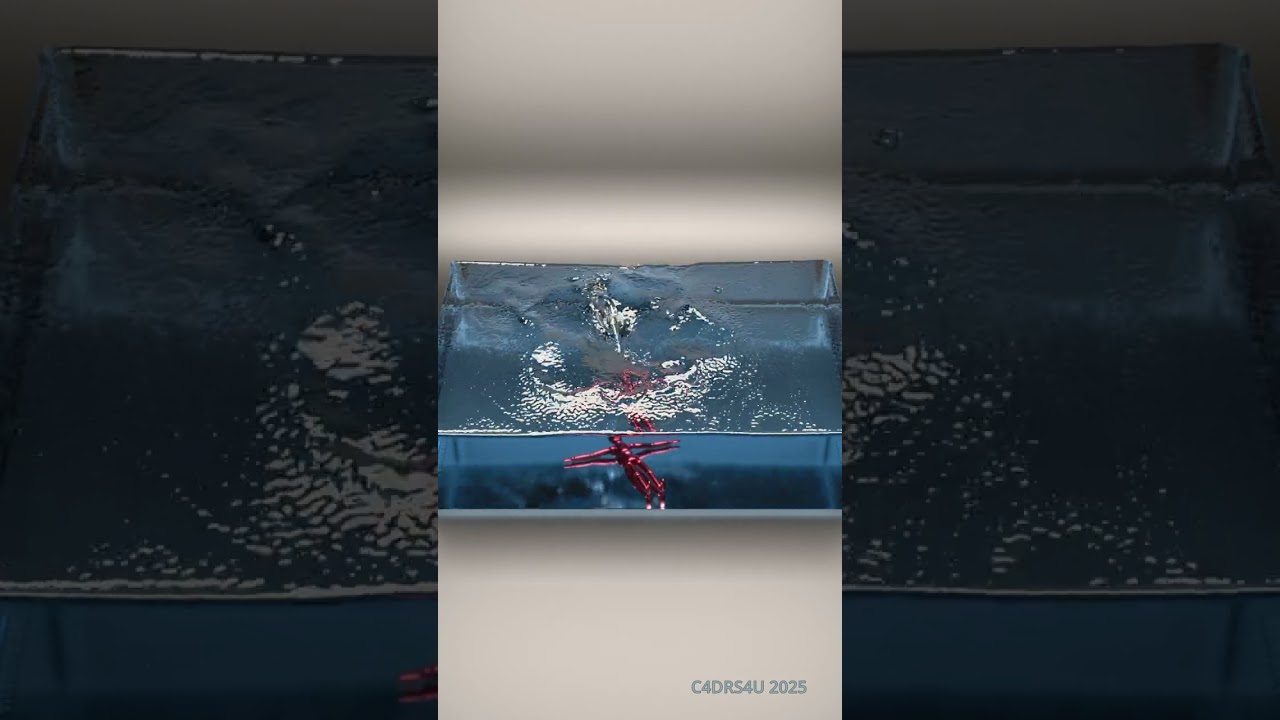
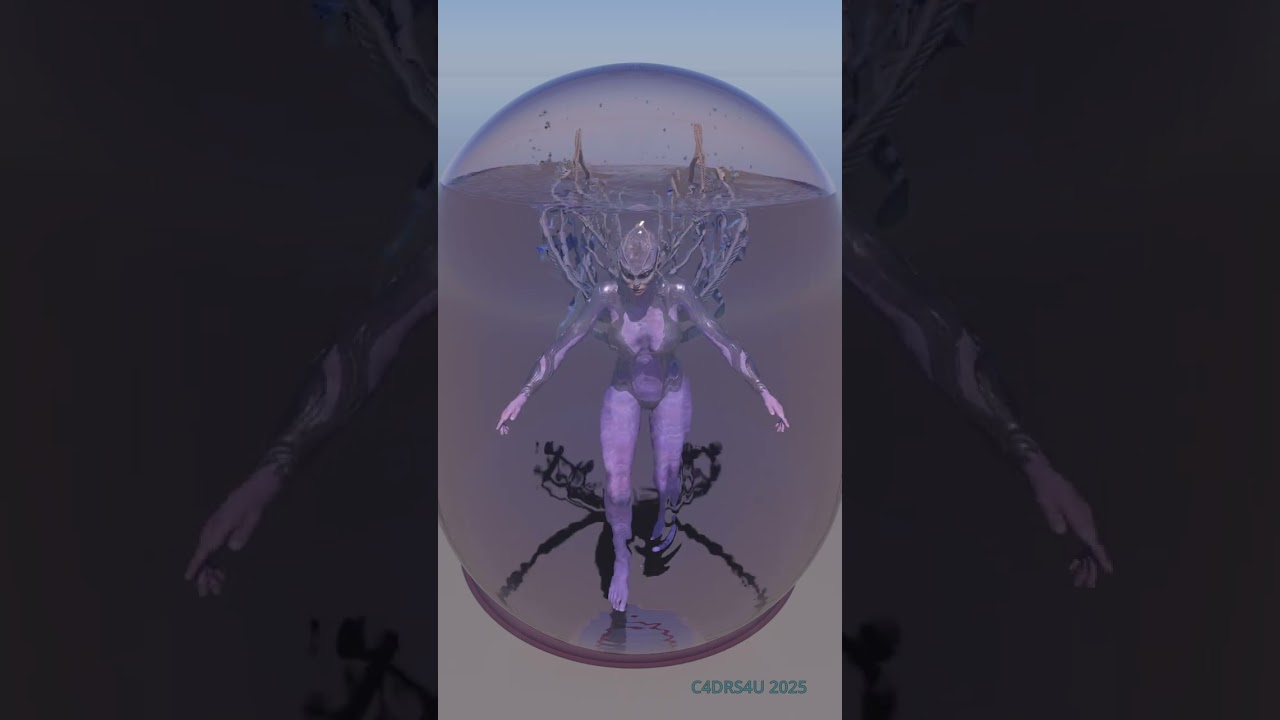
I’ve been experimenting with the new liquid sim system that is native to C4D (so far, it’s not bad, but lacks a few of the things X-Particles offers (mainly for spray and foam)):
Torus Splash:
Nice! Glad C4D has finally dipped its toe into liquid sims (pun intended). Gotta go download the latest update! Thanks for posting these–I’d almost forgotten about their promise of “soon”
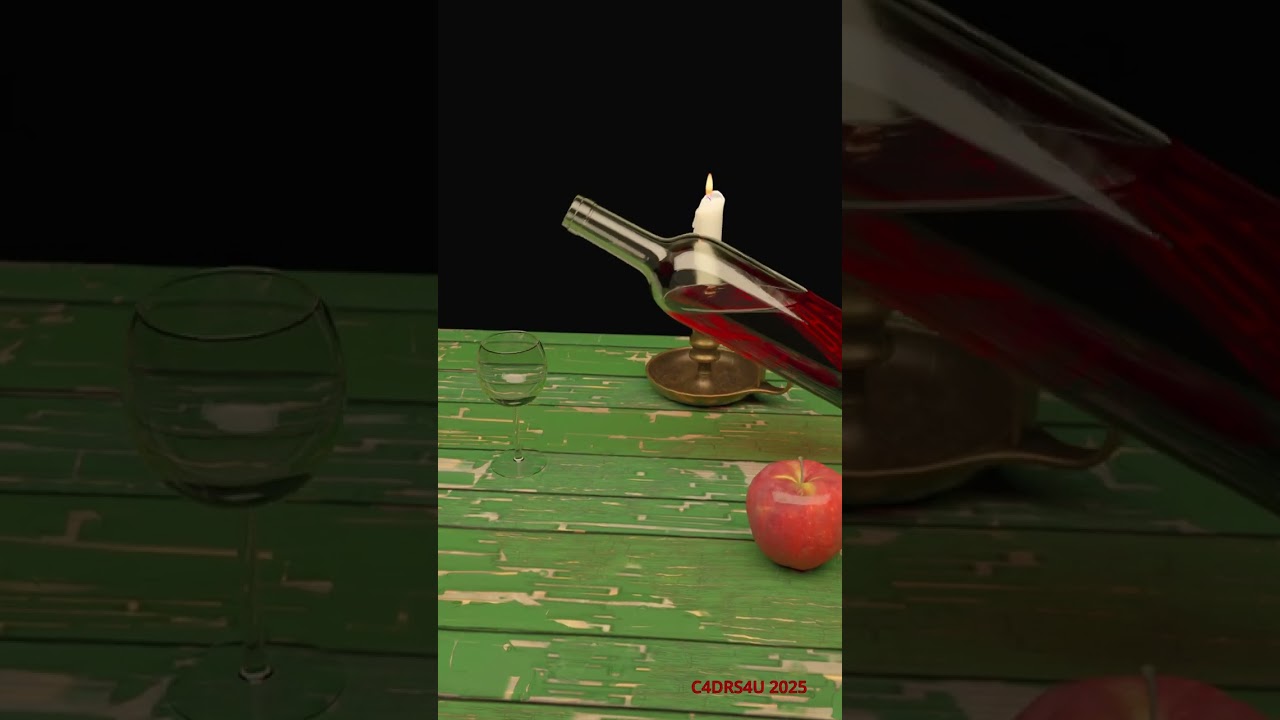
I decided to re-do the “Pouring Wine” animation after figuring out how to get rid of the stray droplets and re-render it at 4K. This is about as realistic as I can make it at this time.
Well, the particle radius is already down to 0.1 cm (1 millimeter)—so quite small— and the viscosity is about as low as I can get it before running into artifacts/issues. The smaller the radius, the more particles the sim and the VRAM need to handle and the more difficult the collision detection becomes: containers become “leaky”, especially if they are being moved around.
So, frankly, I don’t know what else to tweak at this time.
Also, please keep in mind that this is the first “version” of the C4D liquid sim system. The competition for C4D use (i.e. X-Particles—never tried Real Flow) has already gone through several iterations.
Can you maybe point me to a similar animation (perhaps made with Blender or Maya) with “thinner” wine (etc.) that works at real-world scale? (Many fluid simulations I have seen do not operate at real-world scale, and that changes things quite a bit.)
The reality is that it seems that most fluid engines, inside 3DCC’s, fail at small scale liquid simulations of the type we see in our everyday lives (pouring drinks etc).
the closet software I have seen to accurately simulate “thin fluids”
at “Drinking glass scale” like alcohol, is the specialized and very expensive liquigen software
Yes, the LiquiGen stuff looks very cool, especially considering it is “real time”, as was EmberGen before.
The problem is that—as far as I know—any LiquiGen output would have to be exported to C4D as Alembic files and would not work with the C4D unified system.
With regard to 3DCCs, you are saying that Blender, Maya, and Co. don’t have superior systems for simulating fluids at real-world scale (drinking-glass scale), either? I think, perhaps Houdini could do that, but that is not really an alternative for me.
Probably possible with my flip fluids addon (with insane resolution settings) and the same for Maya’s bifrost fluid engine as it is used for Hollywood films but likely jacked up with in house scripting etc.
And Houdini definitely could but I don’t consider Houdini a true 3DCC as it is more of a pure simulation software IMHO
The thing is, when it comes to stuff that should be possible with the 3D tools one has available, it often does not work out. I have had projects that I had thought simple, but turned out to be anything but. And some of them I haven’t been able to figure out and had to shelve them.
Especially simulations—whether liquid or cloth—are very unpredictable in my experience. They require a lot of trial and error as well as a good deal of time (even with GPU support, my sims in C4D are never real-time; 2-4 seconds per frame is what I would consider fast, but the time per frame can quickly reach multiples of that). I have no idea how LiquiGen does it.
I totally get that some people rather use morphs for deformation than simulation, because morphs are more controllable. Then again, there are things morphs won’t do (I don’t think they would work for a convincing, semi-realistic liquid simulation).
Truly realistic simulation of things like Cloth fluids and hair
(even ragdoll simulations) have always been done with purpose built tools In the past.
As some of the major 3DCC’s have either purchased one of those solution as Autodesk did with the once stand alone “Niad” system
that is now called “Bifrost” in Maya.
And when they develop their own,( which is not an easy task), it typically has to be compromised to be part of a larger feature set of a 3DCC and can never compete with the special purpose apps built to do that one thing and nothing else
( such as Liquigen).
It seems to be the way the economics of how software development works
Even to this day, nothing can really compete with my 20 year old Endorphin software for ragdoll physics ,not even cascaduer.
So it seems there will always be a need
for standalone solutions for the top quality VFX simulations outside of big VFX studio who often create their own as well.

 A paid project is not an option for me (for a variety of reasons, I couldn’t accept money for CG), so the only other alternative would be me not doing the sim and not posting anything, which I don’t find all that appealing, either.
 and grabbed yesterday