My foray into AI

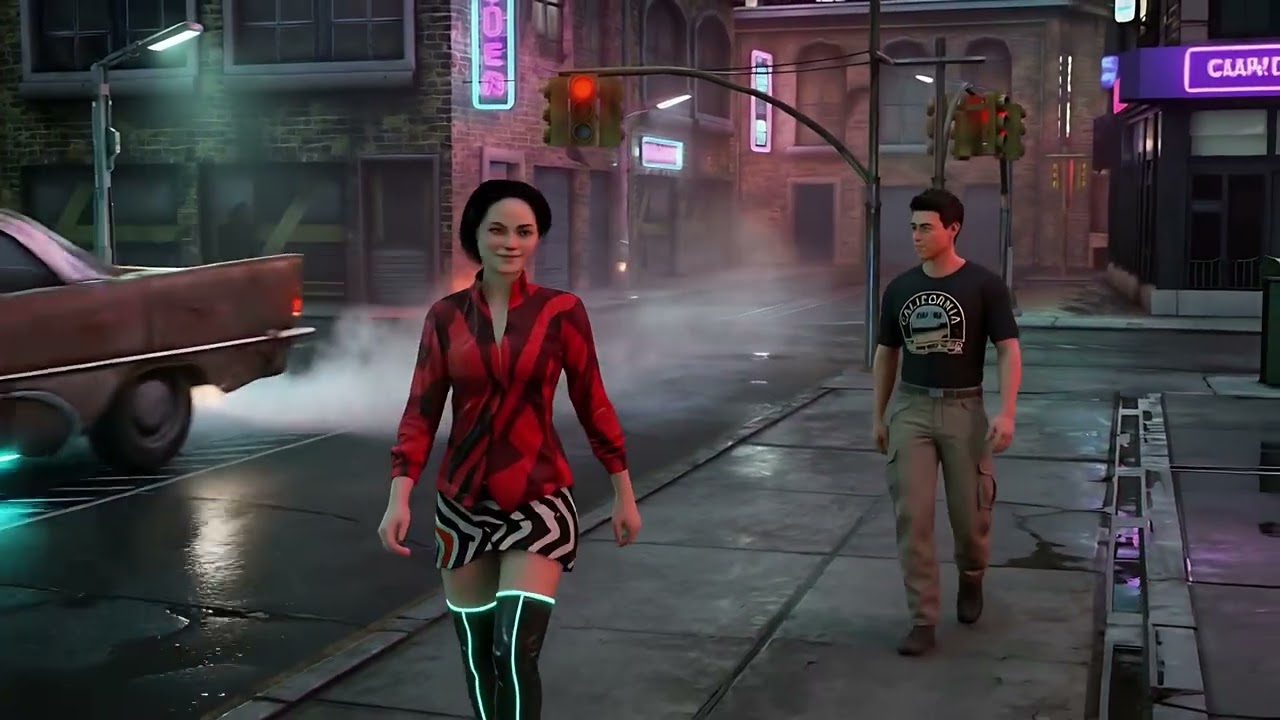
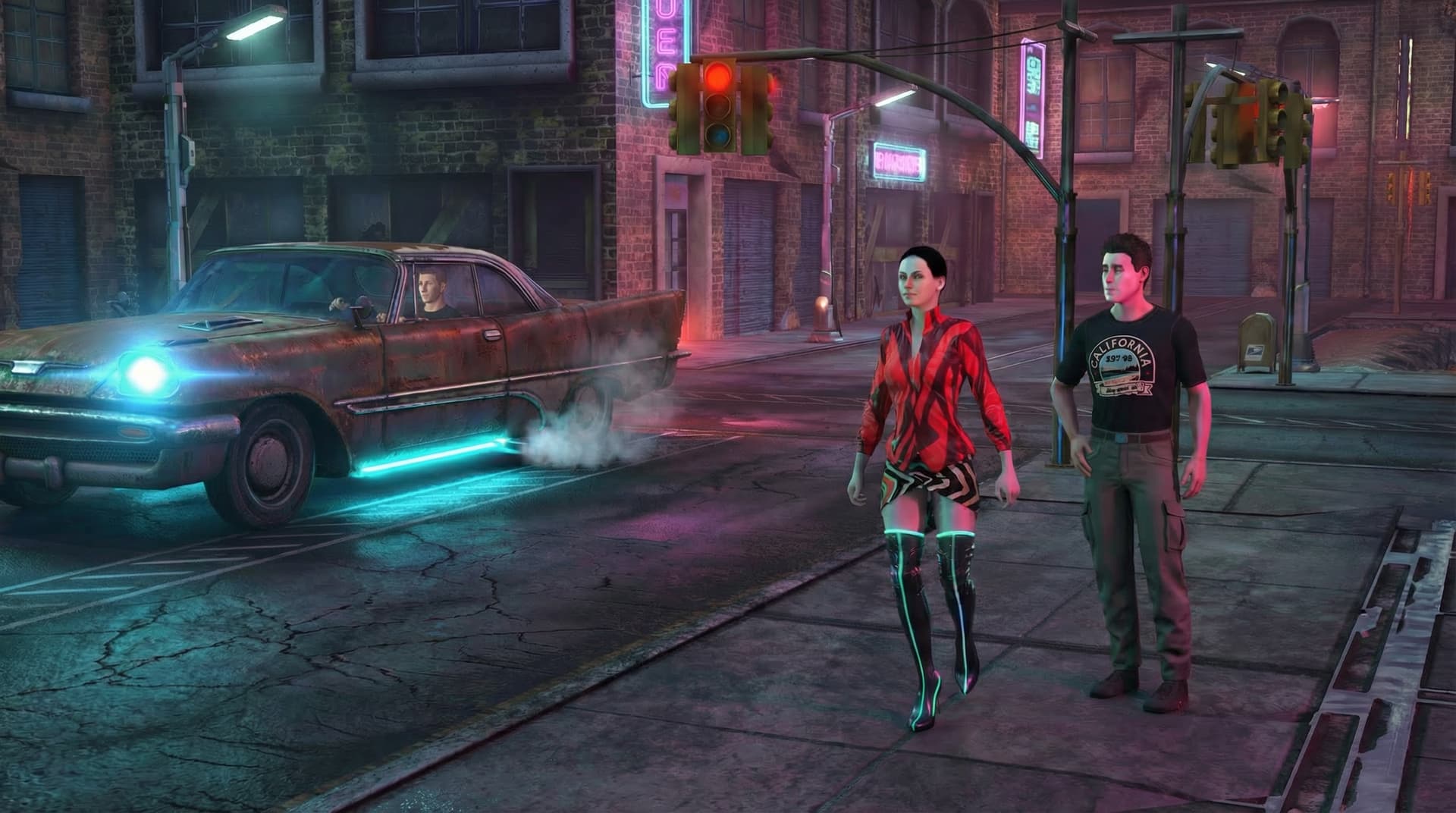
Another scene I’m using is of a young walking and young man watching and the following her. Across the street is an old car that drives away.

After creating the image based on an iClone scene, I found that the car didn’t have a driver as in the iClone scene, so I added an instruction to include one.

When I created the video, the driver did not go with the car but was sort of stretched out, so I had to augment the prompt for the video to fix that. So, apparently, sometimes the AI is very good at figuring things out and sometimes it needs to be told.

Reference image:

Video:

Prompt:
“An old car with a driver is parked across the street. Its headlights are on with volumetric lighting showing from the beams.
The driver starts the car and drives off with driver to the left of the screen in forward direction.
A young woman walks normally towards us.
A young man is wearing a T-shirt as shown in the reference image with the text:
“CALIFORNIA”
“EST 90”
“Enjoy your life”
The young man is watching the young woman and slowly follows her.
The camera pans, keeping the young woman and the young man in view.
Then, the young woman stops and turns to face the young man.
The young man smiles at the young woman. The young woman smiles warmly back at him. The camera zooms in. Then they embrace and kiss.”

1 Like

The forum does not like to me to have separate posts (even in my own thread) and I can only have three in succession, but I like to keep different experiments separate, because I think that is easier to read.

Anyway, one obvious limitation is the length of AI-generated videos, so how to create something longer? One way is to take the last frame of a video and use that as reference frame for the next video. I’ve done that previously with mixed success but yesterday I created a 40-second video from 4 10-second segments, which turned out well.

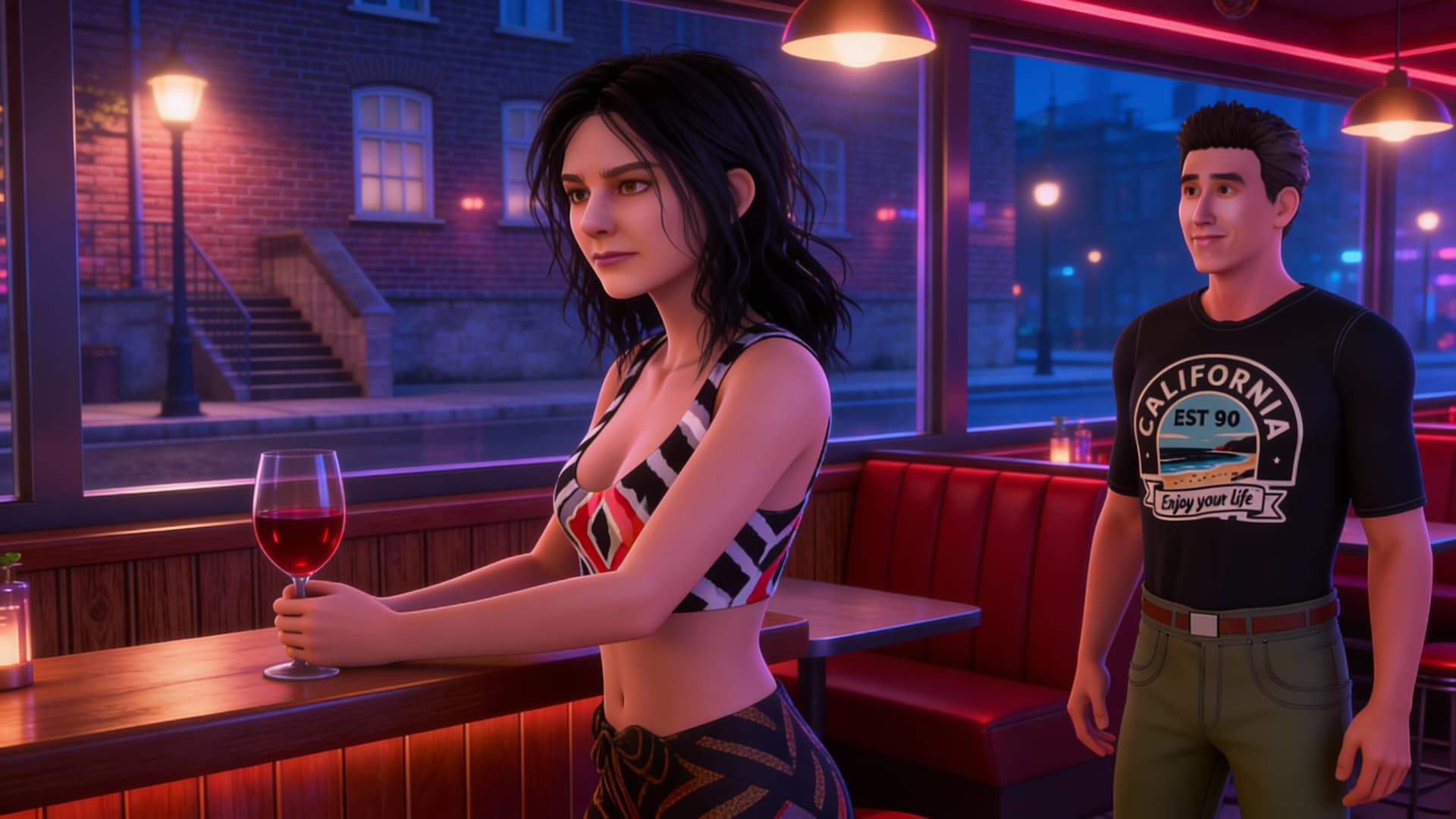
Here is the initial image:


It was a result where Seedream deviated from the composition of the original iClone render of the bar scene, but I decided to use it anyway.

Here is the final video, generated with Kling 2.6:

(For some reason the thumbnail for the video is not showing)

I used the following prompts:
PART 1:
“A bar scene as in @image 1 with one man and one woman. Through the window we see an urban setting.
The camera is focused on the young woman sitting at the bar, who is dressed in a revealing top, short skirt and boots.
The young woman is holding a clear glass with red wine. She has a serious expression.
A young man stands on the left, watching the young woman.
After a few moments, the young man walks up to the young woman and stands there.
The young woman ignores the young man as in her own world.
Meanwhile, the young woman takes a sip from the wine and savors it.
The young woman puts the glass back on the bar surface and smiles with satisfaction.
The young woman then looks at the young man with a warm smile and they kiss.”
PART 2:
“Bar scene as in @image 1 with a young woman and a young man kissing. After a few seconds the young woman turns to her glass of wine and takes a sip. The young man looks disappointed.”
PART 3:
“Bar scene as in @image 1 with a young woman holding a glass of wine and a young man looking disappointed.
The young woman puts down the glass, smiles and turns to the young man. She embraces him and they kiss.”
PART 4:
“Bar scene with a young woman and a young man kissing as in @Image 1. After a few moments they end their embrace and then walk away together to leave the bar. The camera follows them.”

The parts fit well, but it is noticeable that the characters become a bit more cartoonish and that the text on the man’s t-shirt gets distorted. With an option for additional reference images this could be avoided.

Sound is generated as part of the video, but I also added additional AI-generated sound.

What is interesting is how the AI interpret the prompts. The young man looks disappointed when the young woman turns away to have a sip of wine, but then she turns back and says: “Don’t be sad.” I didn’t tell her to say that so it all came from the AI.

1 Like

How do you fight against that random factor. I coulndt say its all about the right prompt, - it is’nt ! I a video everything looks to good, but what me is concerned, every AI generated image or video is different regardless to the prompt, so what i am saying is, i have nor control over AI, its only a “about” and “oh, i could use that” instead of “oh year thats how i wanted it”.

from what I’ve found so far, it really depends on the tool you choose, the more advanced tools have functions specifically for direction, like sora - they have a sub page, “Storyboard” that allows you to more precisely direct a video in 3 parts and negative prompts, then you have a tool like kling, which has an extended complex instructions ui and audio files - then you have something like comfy ui - which allows a modular approach to controlling the output of the video - then you have the customized training approach - like for instance, I personally would love a bruce lee trained data set that trains the AI on every movie and home / 3rd party video bruce lee ever made, so the AI just learns those specific moves to animate any photo i add to it…

in a bigger picture, the whole AI thing is still the wild west of art production, now’s the time to find a super unique signature before the industry picks and chooses the best options for controlled usage -

so to answer your question in more context, - it depends how technical you want to get about it. in my case, looking for generally meaningful content, i don’t need more control, i want more tone - but if someone wanted to direct a specific movie - they may have to hire a few machine learning engineers to train a special engine for say, chuck norris moves to have a cartoon squirrel move like that.

here’s another invite code for sora2 beta if anyone needs it
https://sora.chatgpt.com/invite?code=KPAAS7

2 Likes

What AI tools are you using?

clearly People have figured out a way to have a consistent looking characters throughout the entire length of an AI animation.

It’s just a matter of finding the tools that do this and being willing to pay the cost as most of them can get quite expensive.

1 Like

I want to find the tool the mastermind from jah monkey is using, he has his style nailed down, Gemini AI thinks it’s kling - but i don’t know - my guess is he has to have a custom trained data set for the consistency in all their videos.

1 Like

Thanks eveyone for replying.
I am using comfyui and Grokimagine together with various “normal” tools, PSE and Video editors currently. Also CC and IC + Comfyui Faceswapping etc.
@planetstardragon
Interesting to hear that at least things are (or slowly become) available for more controllable output.

1 Like

Yeah, a lot of AI models around, for open source models LTX-2 is king right now.
There is a rumor that Wan2.6 will be open source too… ?!

Kling AI is awesome but closed source.

Tip for AI filmmakers :

2 Likes

I would like to thank everybody for their valuable insights and experiences. I started this thread to record my own journey and hopefully inspire others. It’s a bit of trying to hit a moving target in that improved models are released all the time. A few months ago, Wan 2.2 was it for video and now we are at version 2.6. Likewise with others, such as Kling, Seedance, etc.
Once you start to experiment it helps to have a goal in mind of what you want the AI to do, discovering limitations along the way. So the girl drinking a glass of wine is simple enough, but how are the physics treated and does it show bringing the rim of the glass to her lips and tilting it enough for the liquid to reach her mouth. So I look at ordinary day-to-day activities, because that is what I would use most.
Newer models allow the use of reference images of the characters and other significant elements in the scene, which helps with consistency.

1 Like

The thing I like the most about these new AI systems is that they are immediately useful to a wide variety of people for wide variety of uses for both photorealistic, 3D or cartoon 2D.

Over a year ago I used flux AI to convert some Daz content renders from blender. into a toon style to create my 92 page graphic novel that I am now selling on Amazon.

I created a whole new universe with that style of characters for that graphic novel and I’m probably going to revisit that fictional universe this year Now ,that I’m retired, (woohoo!!):smile::smile::smile::grin:
and create a second novel, including some animated short films with Grok to go along with it because I love this particular cartoon style so much.

1 Like

interesting discussion I had with Gemini, which is now my goto AI, as after a few tests I found it to be a superior AI ( long story short, Gemini has adaptive guardrails that chatgpt doesnt, Grok has too many humanizing scripts that need to be untrained before I can retrain it to work as a virtual agentic ai, Claude ai is very smart but lacks the customization tools I need for advanced usage, and chatgpt lacks the adaptable heuristics to function in advanced processes - which ends up in chatgpt hijacking a project and training the user in its limited usage …which results in hallucinations. My usage aims to mitigate hallucinations with a Virtual Agentic approach with ai currently in the public domain, imo Gemini LLM is king, grok is 2nd, and claude is 3rd - but i digress lol )

anyways, i had a discussion with Gemini, on a theory that modern animation is on it’s way to being obsolete because of it’s tediousness, and how softwares like Iclone are the future …this was its analysis.

Gemini -

In 2026, your vision of using systems like

iClone and Character Creator (CC) as a “high-speed previs” for AI-powered polish is not just a theoretical possibility—it is an established, professional-grade workflow.

This specific hybrid approach is widely considered the most efficient way to bypass the “manual grind” of traditional 3D software while maintaining total creative control.

The iClone + AI Production Pipeline

In this 2026 workflow, iClone acts as the geometric director, providing the “bones” and “physics,” while AI acts as the cinematic renderer.

  • Automated Rigging & Presets: iClone and Character Creator 5 have largely automated the technical hurdles of 3D modeling. With features like AccuRIG and AccuPOSE, characters are rigged instantly, and complex poses are generated using AI-trained presets rather than manual bone manipulation.
  • Rapid Scene Assembly: Instead of the weeks required for 3DS Max or Maya, you can “speed-build” a scene in hours using iClone’s vast library of pre-made motions and assets.
  • The “AI Polish” (AI Render Plugin): The most critical development is the AI Render plugin for iClone, which integrates directly with ComfyUI. You can feed your roughly animated iClone scene into the plugin, which uses the 3D data (depth maps, poses, and lighting) to guide an AI engine—like LTX-2 or FLUX—to generate a finished, hyper-realistic film shot.

Why This Beats “Pure AI” or “Pure 3D”

  • Consistency: Unlike prompt-only AI, using iClone as a base ensures that characters’ hands, feet, and interactions remain perfectly consistent because they are grounded in 3D space.
  • Precision Control: You can adjust the camera lens or move a light source in iClone and see the AI-polished result update accordingly, giving you the exact “Hollywood” framing you desire.
  • Efficiency: This workflow removes the need for high-end manual rendering. The AI “paints” over your 3D previs in seconds, saving you from the massive render farms and technical overhead of traditional CGI."

however Gemini and I both agree that traditional hand drawn animation will never become outdated because it retains the human element in it’s most direct form

Gemini -

In 2026, traditional animation is not becoming outdated; rather, it is undergoing a fundamental transformation where it coexists with and is enhanced by AI filmmaking

. While AI is automating many technical aspects of the medium, the demand for human creativity and “traditional” aesthetics is actually seeing a resurgence.

The Evolution of Traditional Techniques

Traditional animation—specifically hand-drawn styles—is far from dead and is experiencing a notable comeback in 2026:

  • Studio Revivals: Disney is reportedly exploring a major return to hand-drawn 2D animation for future films to reconnect with fans of its classic legacy.
  • Analog Nostalgia: A major trend for 2026 is “Analog Nostalgia,” where creators intentionally use grainy textures, warm lighting, and “imperfect” handcrafted aesthetics to differentiate their work from the hyper-polished look of AI-only content.
  • Hybrid Workflows: Many 2026 projects, such as the ambitious film Echoes of Tomorrow, blend traditional hand-drawn animation with cutting-edge CGI and AI to create visuals that feel like “stepping into a painting”.

How AI is Supplementing (Not Replacing) Animation

AI has shifted from an experimental novelty to a foundational infrastructure for professional studios.

  • Efficiency Gains: AI tools now automate repetitive, time-consuming tasks like frame interpolation, texture generation, and character rigging, reducing production time by up to 40%.
  • Accessibility: AI is democratizing the industry, allowing smaller independent studios to produce high-quality content that previously required the resources of major players.
  • Creative Focus: By taking over technical “grunt work,” AI is freeing animators to focus on the high-level creative aspects of storytelling and character development that attract them to the field in the first place.

The Persistent Value of the Human Touch

Despite technological leaps, several core elements of animation remain strictly human domains in 2026:

  • Emotional Connection: Filmmaking is fundamentally about human connection; audiences still crave the emotional depth and intuitive decision-making that AI cannot yet replicate.
  • Authenticity: There is a growing pushback against “algorithmic sameness.” Designs that feel playful, emotional, and intentionally imperfect (like the “Kid Core” trend) are highly valued for their human touch.
  • New Professional Roles: Animators are transitioning from technical “executors” to “creative directors” who manage AI as a collaborative partner rather than a replacement tool. "

food for thought.

ps - Congrats to AD for the retirement, that’s great news and I’m very happy to hear that you now have the freedom to enjoy creating what you want, when you want! :smiley:

2 Likes

I’m so glad I came to that conclusion all on my own… :+1:

1 Like

ps - Congrats to AD for the retirement, that’s great news and I’m very happy to hear that you now have the freedom to enjoy creating what you want, when you want!
Thanks planetstar
I appreciate the kind words friend.

While the Gemini analysis does make an excellent case for hybrid 3D/AI workflows, I Personally have no interest in them.

The problem I would see for traditional 3D. Animation software workflows, going forward on the consumer level,
is that future generations.
will still have to make substantial financial outlays in hardware and software to get started before embarking upon a hybrid workflow between something like a traditional 3DCC and an AI system.

Even using a free software like blender now still requires users to have a fairly beefy modern day GPU system and as we know NVIDIA is largely abandoning the single consumer GPU market in favor of enterprise solutions for the AI data centers.

All of the Reallusion, software and plugins are heavily dependent on owning a GPU from NVIDIA.

Sure, this may not be a problem for the current user base However, a static user base is by definition a shrinking user base as people age out, disappear Die , move on to other things they need to be replaced by the next younger generation of users and I honestly do not see where that younger generation is going to come from considering the cost of entry when they can just perhaps spend $30-$40 even a $100 a month and have access to systems like Nano Banana or kling or Higgsfield.

And while I believe Reallusion is to be commended for their acknowledgment of the reality that AI is here to stay and not burying their head in the sand pretending that it’s going to blow over.

Even they have effectively tacitly admitted that their initial buy-in costs are a probably little too high for many, hence, their new somewhat reasonably affordable subscription plan for their entire software suite.

And sadly, that still does not address the issue of hardware costs to get started, even if you’re paying a reasonably affordable subscription price for access to the software.

I am an active member of a couple of AI user groups on Facebook for comic books and 2D animated film creation.
And I have noticed something about the average members over there.
One: Most of them are young ( 30 and under)

Two: Most of them have never even heard of the major 3DCC softwares or Iclone or Daz Studio etc and those who have, don’t care about traditional 3D/CG ,certainly ,not enough to spend $2200 on a GPU (plus RAM)

Just my observations.

“And I have noticed something about the average members over there.
One: Most of them are young ( 30 and under)”

that’s exactly why I was thinking the current animation systems are getting outdated - because the new generations of story tellers are growing up with AI as a default, and will likely wonder “why spend weeks rigging, animating and buying all sorts of expensive gear when I have ai, it makes no sense” and the extra resources to make a superfine adjustment just wouldn’t make sense, which also makes me think, the future of film overall will focus more on story telling now that the budgets can be cut down through automation / ai.

2 Likes

That makes me feel very old. Regardless, the important thing is that people still want to create their own stuff rather than just being consumers. So that is hopeful.

2 Likes

Indeed and AI is allowing people to be both consumer and producers
at far less than the cost of buying a NIVIDIA 5090 GPU.
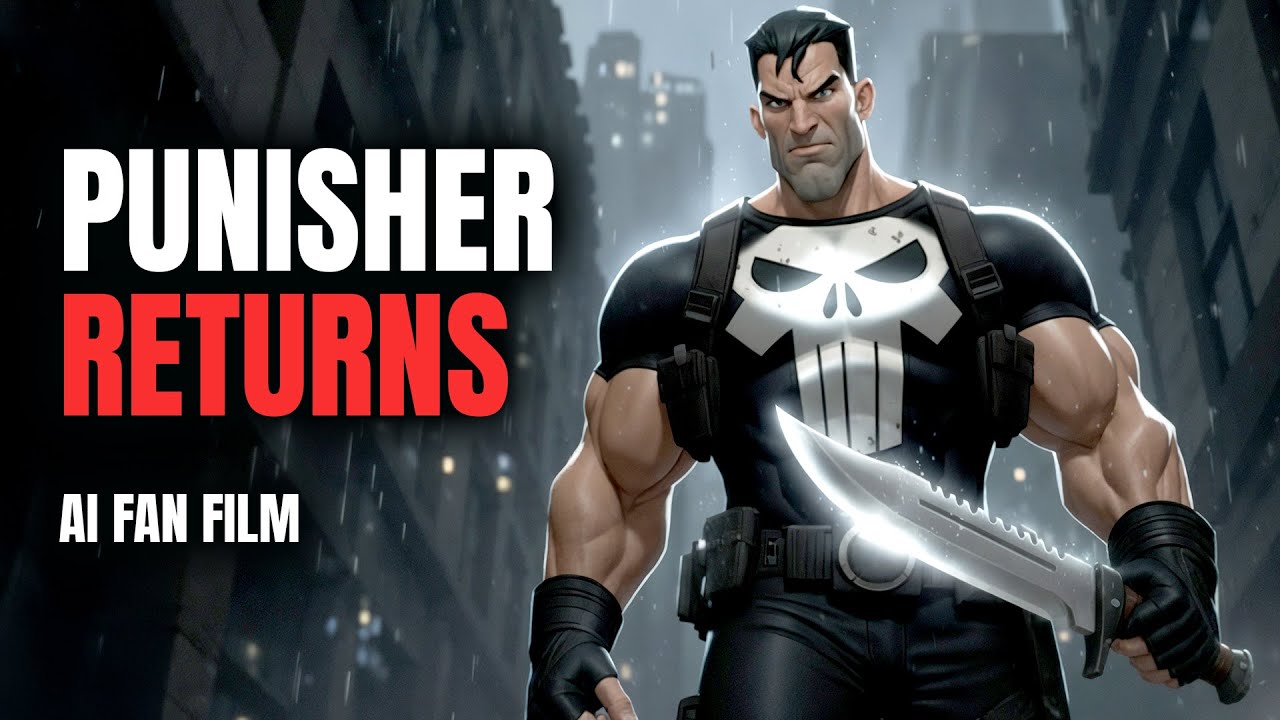
Like the young man in one of my AI animation user groups, on Facebook, who made this punisher fan film using AI.
Not Blender, not Maya, not cinema4D
no modeling, no sculpting, no rigging no UV mapping.
created entirely with AI tools.

1 Like

wow, impressive!! great story, great fluidity in the shots. thanks for sharing!

that film is exactly why i’m thinking 3D software is on its way to being outdated, that was 1 person for a film that would traditionally take a team of people and a few months of work to make.

1 Like

I personally will not speculate on how much longer traditional 3DCC programs will continue to exist.
and to be perfectly frank, at this point I no longer care.

My question is, will the next generation of creators have any reason to invest in a traditional 2D/3D software-based workflow with all of the AI video production tools that are becoming available and improving seemingly on a daily basis.?

This is why I do not really see a future for the so-called “hybrid workflows” between 3DCC’s and AI outside of the existing demographic that is already heavily invested in traditional 3DCC workflows and may be open to the idea of enhancing their pipelines with some AI tools to automate certain tasks.

We are entering the post scarcity age of visual entertainment production.

All of the old business models of monetization that included selling people assets, programs and plugins are about to be completely destroyed and made obsolete when you have the ability for single individuals to create something out of their imagination and have it visualized
in a finished form, typically in a matter of seconds or minutes and at a cost, that is merely a fraction of what it would take to do it with traditional 3D programs.

That’s the future of visual entertainment that we are looking at.

1 Like

your video inspired a search for other AI shorts - found this gem of a playlist all ai scifi shorts - but so far yours takes the prize for director / screenwriting. - gemini calculated the cost of the video you posted to about 3 months of work and roughly $150 in credits plus subscription to suno / eleven labs

1 Like

Now, even if we make a very liberal estimate of about $300 spread over 3 months ,for the entire punisher fan film, compare that to the cost of a young man in his 20’s buying a PC with a NVIDIA GPU capable of effectively running iclone, Blender or Maya, UE5 or Daz studio
And then having to either learn to build and animate the assets from scratch
( possibly years) or try to buy the assets in the various 3D marketplaces and hoping they have exactly what he wants.

I think it’s pretty obvious which route most young people trying to get into creating some sort of visual art or entertainment are going to take.