The pose “Reclining_Floor_01.rl” in the CC5 content library i have found to be an excellent test for long gowns or dresses or robes or anything that goes beyond the knees and is flowing. I have found that nothing passes that test. Either the fabric stretches inappropriately or falls apart of swings wildly out and away from where it should be.
All of which leads me to wonder if there is no physics solution and that the software is fatally flawed. DAZ has the same problem. Robes that go wonky.
This is a problem for anyone doing animation or poses that utilize long cloth.
Nothing i have seen in the tutorials, even when you follow them step by step solves the problem.
I’ve tried “trial” dress or gown after “trial” robe or whatever and they all fail. (I assume the creators of these garments know far more about the proper construction of their cloth than i do, so i am depending on them to produce workable cloth.)
There are a few problems here.
-
Physics engine in RL is quite old and based on Collision Shapes objects which have to be properly positioned. But even then those shapes may move out of desired boundaries with extreme poses. In which case I recommend making External Dynamic Shapes Dynamic Collision Shapes for Soft Cloth in iClone which brings us to the next point.
-
You will not have those poses you mentioned to work properly with Physics in Character Creator. Most any 3D app with physics feature would require animation tools to be present to have a smooth transition from a bind pose to any other desired pose. In CC you could barely have Physics to work properly for the basic standing poses. Anything more complicated, could be achieved in iClone though, where settled physics transition from a bind to target pose can be animated.
-
Aside from mentioned, there are other aspects, such as physics parameters configuration for particular animation, making sure cloth is not getting jammed between collision shapes (as well as between collision shapes and floor terrain - Infinite plane), etc…
Here is a quickly made animation for 3 different poses in iClone. Not perfect as if I needed that for production, I’d spent much more time for perfection.

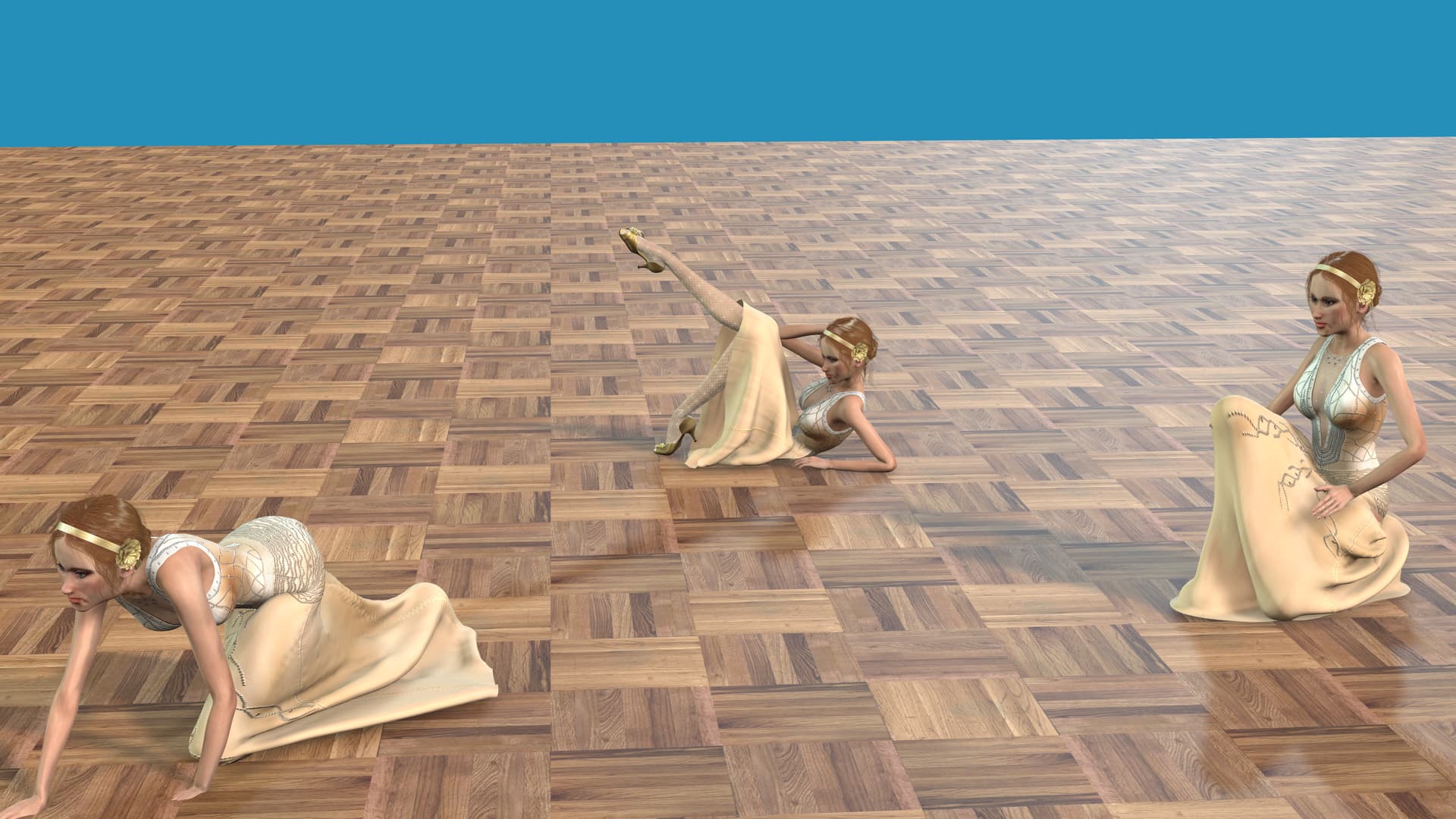
And even in this animation to have a mini skirt to behave more or less naturally, I have introduced a dynamic collision shapes and animated them separately for certain poses.
Thanks for taking the time to enlighten me. Unfortunately, i don’t own iClone and am unsure what i would use it for beyond what you point out. Everything i do with CC5 is brought into 3ds Max to pose and/or animate as part of a larger scene. For me, CC5 is simply a plug-in for Max.
You say CC barely has physics to work properly for standing poses yet in the “Create Clothing from OBJ Files” Reallusion tutorials, the author shows a character wearing imported clothes snapping to an excited pose with no problem. Is this tutorial a fake? The author presents the import as simple and nearly effortless but replicating that has been impossible for me. The results are nothing like what is shown.
What tutorial was that?
I honestly cant even get a gown to work properly with a walk animation…
You should not even attempt to…
Again, a great misconception about assets such as long dresses, skirts, capes, robes, coats, gowns, general baggy cloth, etc… You should not pose or animate them in CC and expect them to be presentable.
If you animate/pose a character wearing one of those without physics simulation enabled, the cloth is stiff, it’s stretching and goes through legs.
Animating with physics enabled might be even worse depending on initial pose. I already mentioned briefly above - any animation with physics should be settled in a bind pose and then smoothly transitioned to your animation clip.
Bottom line, such assets should be properly fit and skin weighted in a Bind pose (T-pose, A-Bind pose). All animations and physics simulations however should be done inside target apps with THEIR respective simulation engines (UE, Blender, iClone, C4D, etc…)
Another quick demo - a long dress with no physics enabled vs one with iClone physics

This is the link to the tutorial. Creating Clothing from OBJ Files - Reallusion Courses
That tutorial is about doing a basic tight cloth fitting and skin weighting. But bare in mind, no matter how well a piece of cloth is designed, fit and skin weighted and no matter what app is used to make a cloth, it only works relatively well when soft cloth asset mesh is wrapped tightly around character body mesh. That is a general nature of skin weighting. For the rest of the types of assets I mentioned above (dresses, skirt, robes…etc), there is a cloth physics to simulate a natural fabric flow at animation run-time.
Got it. Thanks. That would explain why getting a simple serape to function properly is basically impossible without iClone.
No problem.
For anyone willing to go down the rabbit hole with physics in CC, I share this rootless, a minute long dance motion suitable for CC static camera. It starts from a T-pose and transition into fast-paced dance movements. Good for tweaking body collision shapes, setting up a proper physics and weight maps. Always run animation in ByFrame mode with loop turned off. Sometimes you have to start animation twice for a proper physics settle.
An old clip with replaced dancer in a long dress…

What about a gown or a robe as a video game asset? would you use bones or a soft cloth set up?
By “using bones” do you mean rigging the cloth itself and animating it at the last step after animating a character?
It would depend on your game engine and available options. I honestly not in game business, so cannot advise much on a subject. You could probably rig your cloth in Blender an animate there as well as it has a lot more advanced tools to animate rigged props than CC or iClone.
That is what I meant, thanks for the insight regardless you have been a big help
Thanks. I’ll give it a look-at.